









Pipe Lining Myth Busting:
Myth #4: Epoxy Pipe Lining is Easy to Install
[addtoany]When apartment owners and condominium boards hear about epoxy pipe lining for their aged and defective domestic water piping systems, it’s often described as a quick and easy alternative to a full system pipe replacement. It sounds appealing: coat the existing pipes, avoid a major construction project, and move on.
The reality is more complicated.
Epoxy lining isn’t as simple as it may seem in a sales brochure, and faulty installation can lead to long-term problems. This post outlines the steps building owners and managers experience leading up to epoxy lining installation, and the factors that can complicate these projects. To keep things specific, we’ll focus on epoxy lining of domestic pipe systems.
>> This is part of a series exploring myths around epoxy pipe lining for domestic water piping systems. Learn more about this series by checking out our intro post, Epoxy Pipe Lining for Domestic Pipes: Busting the Myths, and previous posts, including: why pipe lining isn’t always less expensive than pipe replacement, why epoxy pipe lining isn’t always safe, and why epoxy lining can be more invasive than repiping.
How is Epoxy Pipe Lining Installed?
Epoxy lining installation is a challenging project that demands a highly competent technician. The quality of any installation is only as good as the installer on the day the pipe is lined.
Here’s a look at the installation process and a few of the things that can go wrong at each step.
-
Prepare the Host Pipe
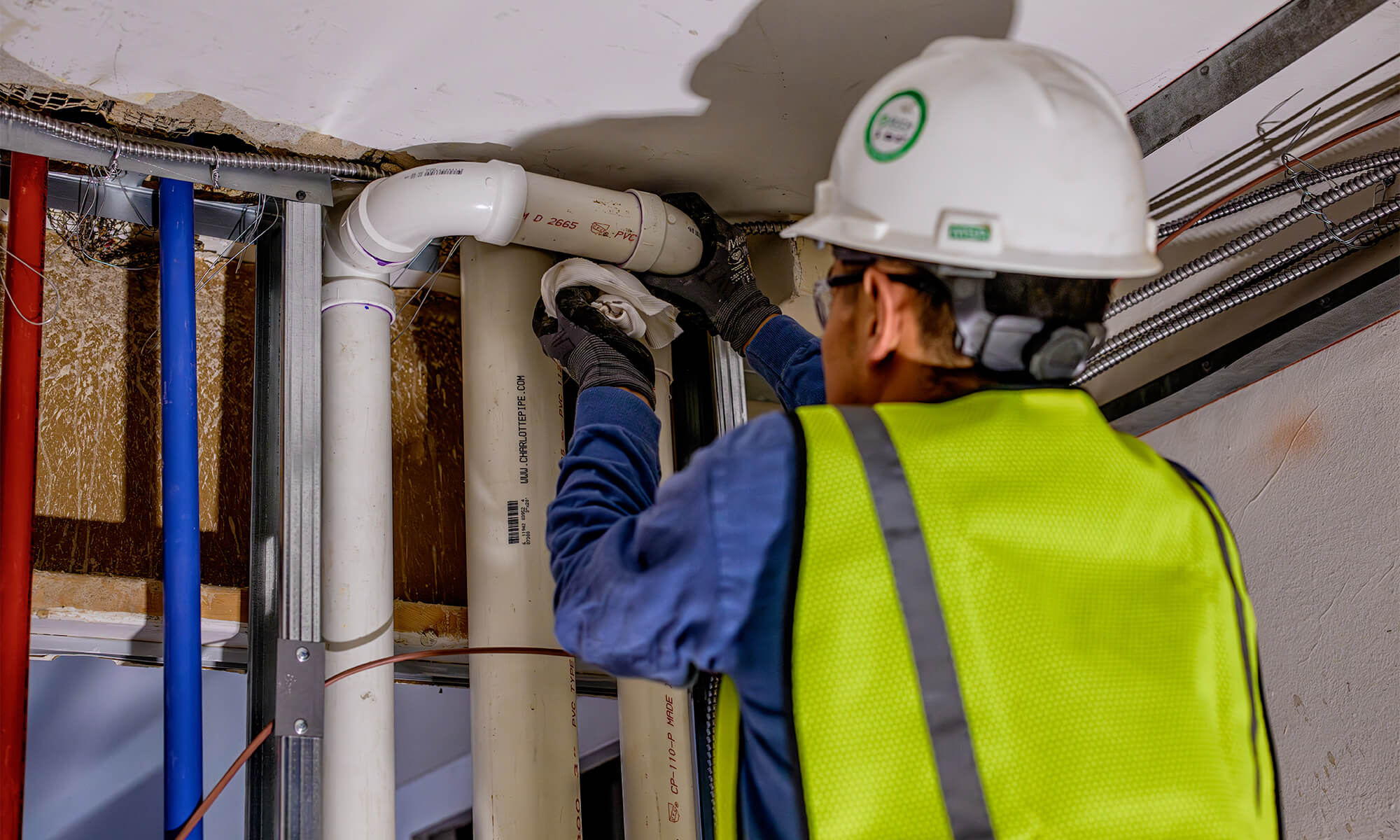
At this stage, contractors get the pipe ready for lining using high-pressure air and abrasives, removing any corrosion, film, or particulate from the inside of the pipe so that it will accept the epoxy. There are two primary concerns with this critical stage: surface preparation and potential “blow-outs” during the cleaning process.
- Surface Preparation

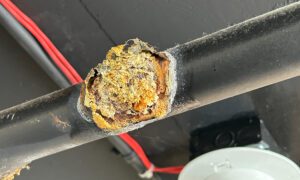
Corrosion grows between the epoxy pipe lining and the pipe’s wall As noted above, contractors use high-pressure air and abrasives to clean and prepare the inside surface of the pipes for lining. If surface preparation doesn’t meet the National Association of Corrosion Engineers specifications, the lining may be susceptible to failure. For example, the lining may not fully or adequately adhere to the inside surface of the pipe, which is called the pipe wall. Obtaining that standard of preparation is difficult in complex domestic piping systems with bends in the piping. This problem is particularly acute past the point of the bend, where the air loses pressure while traveling around the corner—making it hard for the downstream side of pipe turn to get adequately cleaned. Bear in mind that even if the surface is well-prepared, corrosion can return and grow between the lining and the pipe wall, pushing the epoxy back into the pipe. This decreases the pipe’s diameter and may ultimately lead to restricted flow as well as potential perforation or delamination of the lining.
- Blowouts
Cleaning creates significant stress on the system, sometimes resulting in further erosion of the pipe wall. Occasionally, this can lead to catastrophic pipe ruptures. These ruptures are a particular concern in areas of a piping system where corrosion is likely. This includes spots with existing pinhole leaks, anywhere the pipe wall is compromised, and at threaded joints. When blowouts happen, contractors must cut holes in the wall or ceiling and replace sections of pipe before they can be lined. This can be so disruptive and costly that properties end up abandoning the lining project and opt to repipe instead.
- Surface Preparation
-
Mix the Epoxy
The next step—mixing epoxy liner—involves combining resin and hardener in precise proportions. Ambient air temperature and humidity can change the viscosity of the mixed epoxy, which in turn affects factors such as the air pressure required to install it within the host pipe and the cure time needed for it to form a good seal. This means that cold, dry winter days and hot, humid summer days call for substantially different requirements for a successful installation. Bottom line: your property isn’t a controlled lab environment, so you’ll need a skilled technician who understands how to account for the wide range of environmental factors they’ll encounter from project to project (and from day to day).
-
Blow In the Resin
Once the pipes are ready, it’s time to actually install the lining. At this step, the contractor blows in the resin, “shooting” it down the pipe with a high-pressure burst of air. Problems can arise when the technician is unsure of the exact length or curvature of the host pipe behind the wall, leading them to use the wrong amount of air. Too much air and the lining will be too thin. Too little, and it becomes overly thick, resulting in inadequate coverage for sections of the pipe. A couple of factors can make the blow-in process more complex:
- Bends and Fittings
Bends and fittings in the pipe present challenges beyond the cleaning stages that we mentioned above. The airflow around corners (such as tees or elbows) varies from the inside to the outside of the turn. This makes it more challenging for the blow-in process to yield an even coat of epoxy. In a pipe run with a significant number of bends, a contractor may use additional access points to ensure proper distribution of the epoxy. Depending on the complexity of the piping system, they may cut nearly as many holes in walls and ceilings as would be required for a system repipe. - Larger-Diameter Pipe
Larger domestic water pipes (anything over 2 to 2 ½-inches) require the use of a massive volume of air while blowing in the lining. Three-inch to 4-inch pipes are exceedingly difficult to coat with high-pressure air, and many epoxy lining companies will not include those larger pipes in their scope of work. If there are large supply mains on the property, repiping may be the only option.
- Bends and Fittings
How Can You Ensure Your Lining Installation Is Successful?
The number one factor in a successful pipe lining job is the contractor’s skill. To ensure a successful project, start by assessing their qualifications.
Since the epoxy material must only be applied by authorized applicators (people, not companies) trained by the epoxy manufacturer, ask your contractor for written documentation from the manufacturer that every person on the job has been suitably trained and authorized. This is particularly important as epoxy manufacturers are unlikely to honor warranties for applications by unauthorized technicians.
In addition to assessing your provider’s qualifications, Dan Robles, PE from Community Engineering Services, PLLC, makes the following recommendations to ensure the lining installation is likely to succeed, and that you have a contingency plan in place in case it doesn’t:
- Before starting your lining project, perform a condition assessment to determine the remaining pipe wall thickness at pitting and threaded areas. Keep in mind that epoxy does not provide any structural reinforcement of the pipe.
- Review the contractor’s documentation for compliance with the epoxy manufacturer’s specifications.
- Require your contractor to test, record, and document the inspection of their work at time of application. Quality control is critical, and they should provide proof that their installation meets ASTM standards.
- Identify, in writing, the contingency and repair plan if any test or inspection fails at the time of commissioning, or if a failure occurs during the warranty period.
- Ensure that the contractor’s warranty for labor to make repairs matches the epoxy manufacturer’s material warranty.
In Conclusion
Epoxy pipe lining may seem convenient for apartment owners/operators and condominium boards dealing with piping issues. But the installation can make these projects riskier than expected. Each step of the process can impact long-term pipe performance, and mistakes may leave you with bigger problems down the road.
Choosing lining over replacement requires careful oversight and verified qualifications from the contractor. Ultimately, protecting your property and resident quality of life depends on the quality of the work performed.
*
Throughout our myth busting series, we’ll dive into the details of epoxy pipe lining and the repipe process so that you make an informed decision about what’s right for your community when dealing with problem piping. To learn more, contact SageWater for a free consultation about the process and costs of a turnkey pipe replacement.